Food-Grade Containers: What Requirements They Must Meet and How to Choose Them
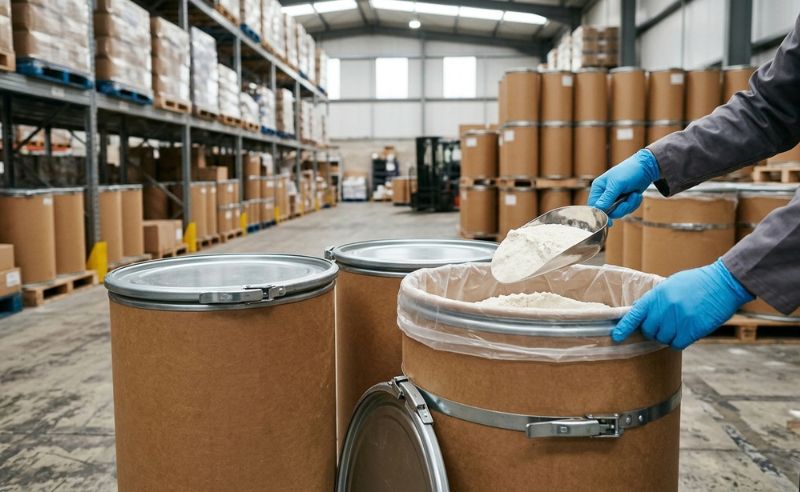
A food-grade container must protect the product without transferring any substances, odours or flavours. And it is not enough for the supplier simply to claim this: they must be able to prove it with documentation. In the European Union, the relevant framework is Regulation (EC) No 1935/2004 on materials and articles intended to come into contact with food.
In this article, we look at which regulations apply, how a kraft cardboard drum is used for food contact, what documentation you should request, and how to choose the right packaging for your product.
Which regulations apply?
Any packaging that comes into contact with food is subject to specific European regulations. Here are the three regulations you should be aware of before choosing a supplier:
- Regulation (EC) No 1935/2004: this is the framework regulation. Materials must not leach components in quantities that pose a health risk or alter the composition, taste or smell of the food, and must ensure its traceability at all stages.
- Regulation (EC) No 2023/2006: sets out good manufacturing practices applicable to all materials intended to come into contact with food. It requires manufacturers to have a documented quality control system in place.
- Regulation (EU) No 10/2011: governs plastic materials. If the component in contact with the product is made of plastic, such as an inner bag, it must comply with the migration limits set out in this regulation and be accompanied by a declaration of conformity.
Furthermore, materials that are not yet in contact with food must be labelled with the words ‘for food contact’ or with the cup-and-fork symbol, unless their use in food is self-evident.
What is a declaration of conformity and what should it include?
The declaration of conformity is the document in which the manufacturer certifies that the material complies with the regulations. It is the first thing a food safety auditor will ask to see, and it is what schemes such as IFS or BRCGS require from their packaging suppliers.
A complete statement must include, as a minimum:
- Identification of the manufacturer or importer and the material.
- Regulations with which it complies.
- Substances subject to restrictions, if any.
- Terms of use: food type, temperature and maximum contact time for which these have been verified.
This last point is key: a material suitable for flour at room temperature is not necessarily suitable for fatty products or for prolonged exposure to high temperatures. Always check that the stated conditions match your actual use.
Cardboard food packaging: how a kraft carton works
In most applications, the cardboard does not come into direct contact with the food. It is standard practice to use a food-grade polyethene inner bag, which acts as a barrier against moisture and contamination and is the component that must be accompanied by a declaration of conformity.
The kraft cardboard body provides the rest of the features:
- Mechanical resistance to impacts during transport and handling.
- Opaque, which protects the product from light.
- Lightweight, which reduces logistics costs and makes handling on site easier.
- Recyclability, once its components have been separated.
The lid with a spring-loaded closure completes the package with a uniform, tamper-evident seal, which also serves as proof that the container has not been opened between packaging and receipt.
Which products can be packaged?
Kraft drums are particularly suitable for solid, powdered and paste-like products:
- Powdered ingredients: sweeteners
- Spices and seasonings: saffron
- Additives and processing aids: thickeners, gelatines, colourings.
- Vitamin and mineral premixes, commonly used in the food supplements industry.
- Teas and herbal teas, which are highly sensitive to moisture and oxidation.
For liquid products or those with high water activity, it is advisable to consult the manufacturer to determine which combination of inner bag and seal is most suitable, or whether another type of packaging would be preferable.
Checklist for choosing your food-grade container
Before requesting a quote, check that your supplier meets these six requirements. This will help you avoid issues during audits and product wastage.
- Declaration of conformity for the inner bag and any components in contact with the product, with conditions of use compatible with your application.
- An airtight seal that prevents the ingress of moisture, dust and pests.
- Capacity adjusted to the batch, to minimise headspace and wastage.
- Traceability: the batch of the packaging is identified and recorded.
- Customisation: screen printing with your logo or a space reserved for product labelling.
- Sustainability: cardboard sourced from responsibly managed forests and components that can be separated for recycling.
Good storage and handling practices
Appropriate packaging alone does not guarantee the safety of the product. How it is stored and handled also matters:
- Store empty drums in a clean, dry and sheltered place, away from chemicals and on a pallet; never place them directly on the floor.
- Keep the inner bags in their original packaging until you are ready to use them.
- Apply the FIFO method to both packaging and packaged products.
- Record the batch number of the packaging alongside the product batch number, so that full traceability can be established in the event of any incident.
- Use a new inner bag each time you fill it.
If you’d like to find out more, our article on raw materials storage explains how to organise your warehouse to minimise wastage and improve control.
Kraft drums versus plastic or metal
| Criterion | Kraft drum | Plastic drum | Metal drum |
| Weight | low | low | High |
| Protection from light | High | Variable | High |
| Recyclability | Yes, by separating components | Yes, depending on the material | Yes |
| Use of rigid plastic | Minimum | High | Minimum |
| Customisation | Screen printing and labelling | Tagged | Labelling and lithography |
A kraft drum weighs less than a metal one, reduces the use of rigid plastic and is recyclable once the paper, steel and plastic have been separated. For companies with sustainability targets, this is a change that is easy to justify to auditors and customers.
Frequently Asked Questions
Is the cardboard suitable for contact with food?
That may be the case, but with kraft drums, the product is usually contained within an inner food-grade bag. It is this bag that comes into direct contact with the food and must have a declaration of conformity.
Can a food-grade container be reused?
The body of the container can be reused if it is in good condition and has been stored correctly, provided that your food safety system allows for this. The inner bag, however, must be replaced after each use.
¿What documentation should I ask my supplier for?
At the very least, the declaration of conformity for components in contact with food and the identification of the packaging batch. If you work with IFS or BRCGS, also check which supplier specifications your protocol requires.
What capacity do I need?
It depends on the density of the product. It is usual to leave a gap of 4 cm.
Find the right container for your product.
At Joaquín Alberto, we manufacture drums ranging from 5 to 200 litres and hold ISO 9001 and ISO 14001 certifications. Take a look at our range of kraft drums or tell us what product you need to package, and we’ll advise you on the most suitable drum, inner bag and closure.
Sources:
Reglamento (CE) 1935/2004, BOE
Reglamento (CE) 2023/2006
Reglamento (UE) 10/2011