How to Prevent Cross-Contamination in the Warehouse
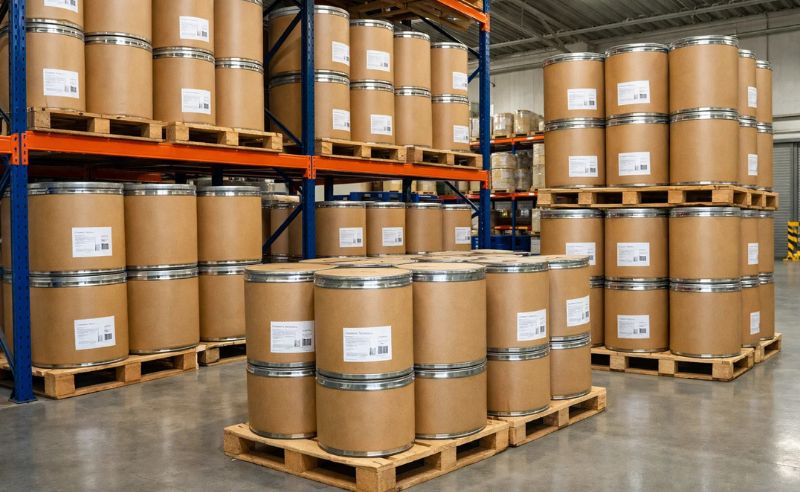
Cross-contamination in a warehouse occurs when particles, residues, or substances are transferred from one product to another during storage or handling.
In industrial logistics, keeping products well separated is essential to maintaining their quality. The risk is particularly significant in sectors such as the food, chemical, or pharmaceutical industries, where even small transfers of residue can affect raw materials or finished products.
Good warehouse organisation and the use of suitable packaging, such as cardboard drums, help to maintain a safe storage environment.
When does cross-contamination occur in a warehouse?
Cross-contamination occurs when a material comes into contact with residues or particles from another product stored in the same facility.
In practice, this is usually linked to incorrect handling, a poorly organised warehouse layout, or the accumulation of dust on equipment and surfaces. It may also be caused by the use of packaging that does not adequately protect the contents.
To minimise this risk, many companies incorporate preventive measures into their quality and safety procedures.
How can you organise the warehouse to minimise risks?
Organising the warehouse into separate zones for raw materials, finished products, or sensitive materials helps to prevent handling errors.
When each type of product has a designated location, daily work becomes clearer for operators, and warehouse management is simpler. Signage for different areas, physical separation of materials, and the designation of routes for machinery are standard practices in industrial facilities.
What role do Kraft cardboard drums play in protecting the product?
Kraft cardboard drums with their swing-top closures protect the contents from contact with dust, debris, or external particles, helping to prevent contamination during storage.
The packaging acts as a barrier between the product and the environment. When the material is durable and the closure system is secure, the contents remain protected throughout the logistics chain.
Cardboard drums offer a stable structure, allow for reliable sealing, and facilitate identification via labels.
For this reason, they are frequently used for solid, granular, or powdered products, where maintaining the purity of the material is a priority.
Why does traceability help to control cross-contamination?
Traceability makes it possible to record where each product is located, how it has been handled, and how long it has remained in each area of the warehouse.
Thanks to this tracking, companies can identify issues more quickly and review processes where necessary. In regulated sectors, moreover, traceability is a statutory requirement.
When the warehouse is well organised, working protocols are consistently applied, and packaging provides adequate protection, the risk of cross-contamination is significantly reduced.
In many industrial settings, kraft cardboard drums are used as an effective solution to protect products during storage and transport.