How to Store Hemp Biomass Correctly
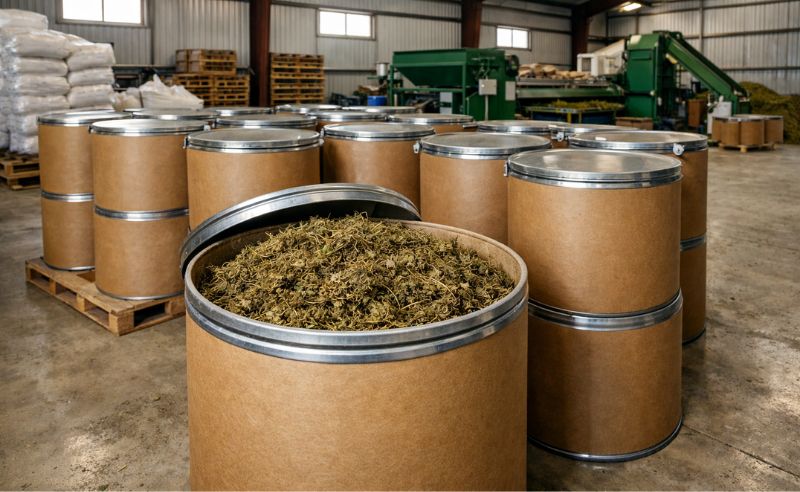
Hemp biomass is a plant material that is sensitive to environmental conditions. After harvesting, its stability depends on controlling humidity, temperature, ventilation, and the type of container used. Proper management helps to preserve the quality of the material during storage.
According to the United States Department of Agriculture (USDA) and studies by Colorado State University, post-harvest handling directly affects the stability of cannabinoids and other compounds in hemp.
How should hemp biomass be stored after harvesting?
After harvesting, the hemp biomass must be dried and stored in dry, well-ventilated areas with a stable temperature to preserve its quality.
Drying reduces the natural moisture content of the plant material and stabilises the biomass before storage. This process is standard practice on farms and at industrial hemp processing centres. Once dry, the material is stored in facilities that maintain controlled environmental conditions.
What is the ideal moisture content for storing hemp biomass?
Hemp biomass should be stored at a moisture content of between 8% and 12%, a range that reduces the risk of mould and degradation of the plant material.
When the moisture content exceeds these levels, the likelihood of microbial growth increases. For this reason, moisture meters designed for agricultural products are used, particularly in facilities that handle large volumes of biomass.
At what temperature should hemp biomass be stored?
Hemp biomass is best stored at temperatures between 10 °C and 20 °C in cool, stable areas where there are no sudden changes in temperature.
Temperature fluctuations can cause condensation to form on the stored material. A cool environment, protected from direct light, helps to maintain the product’s stability during storage.
What types of containers are used to store hemp biomass?
Hemp biomass is usually stored in breathable sacks, industrial containers, or cardboard drums, which protect the dried plant material.
The choice of container depends on the volume of production and the logistics system. Cardboard drums are used in many facilities because they offer a lightweight yet sturdy structure that facilitates the storage and transport of the plant material.
Why is ventilation important in biomass storage?
Ventilation helps to maintain a stable level of humidity in the storage facility and prevents condensation, both of which are key factors in keeping plant biomass in good condition.
Moderate air circulation helps to maintain consistent conditions throughout the storage area. In industrial facilities, environmental control systems are also used to monitor temperature and relative humidity.
How often should stored biomass be checked?
Stored biomass should be checked regularly for changes in moisture content, odour, or texture that may indicate deterioration of the material.
These inspections enable potential problems to be identified at an early stage. Regular monitoring helps to maintain the product’s stability during storage and facilitates its subsequent use in industrial or agricultural processes.
How long can hemp biomass be stored?
Hemp biomass can be stored for several months if kept dry, at a stable temperature, and in suitable containers.
The storage life depends on the condition of the material and the environmental conditions in the storage facility. When humidity, ventilation, and temperature are controlled, the biomass can be kept in good condition until it is processed or used in industrial applications.
Sources:
https://www.mdpi.com/2223-7747/14/3/414
https://pmc.ncbi.nlm.nih.gov/articles/PMC9404914/
https://www.usda.gov/sites/default/files/documents/hemp-research-needs-roadmap.pdf